Bolton House
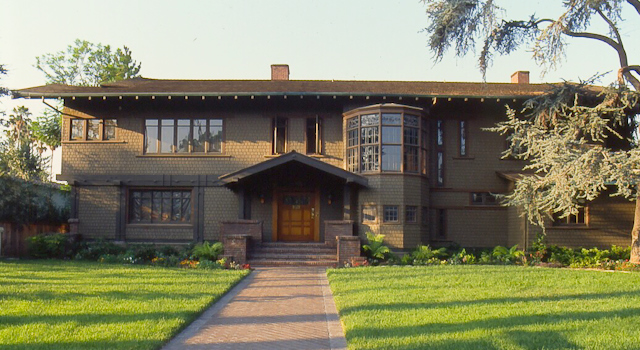
Bolton House as it appeared in 1982 with our new color scheme. Since house was built in 1906 both ends were expanded, living room terrace was enclosed, and a large bay was added, requiring  porch eaves to be clipped.Over time additions altered the original character, proportions and scale of house.  Since most of the changes were over 60 years old, they were considered by some to have attained historic significance.  

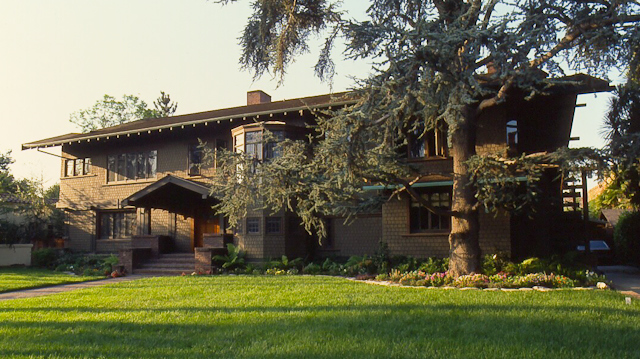
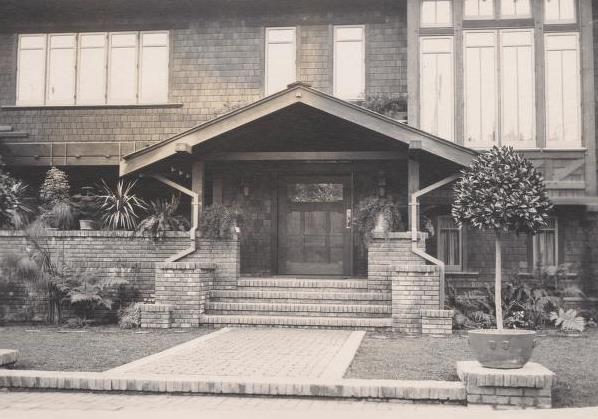
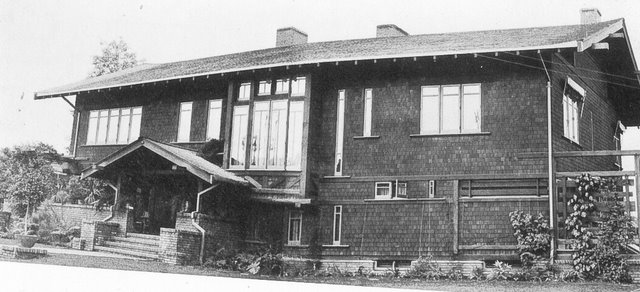
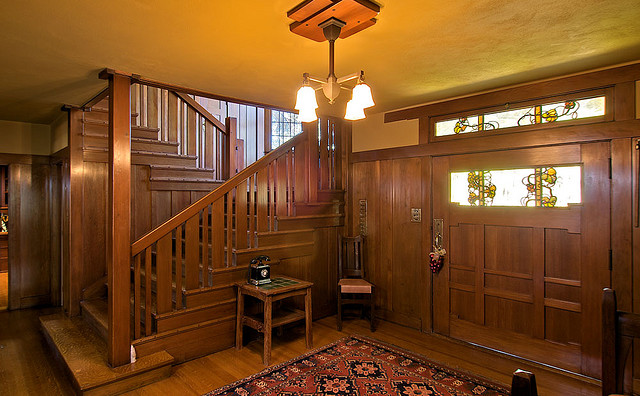
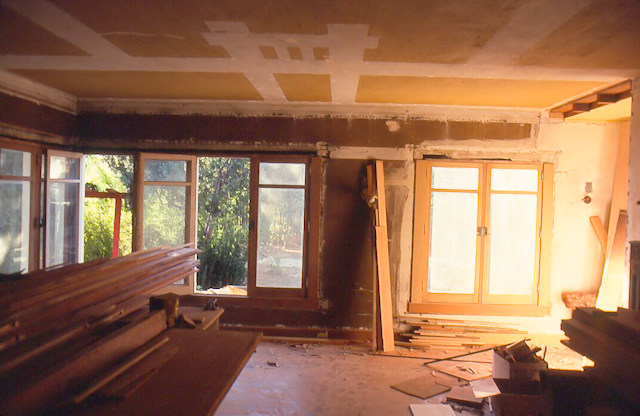
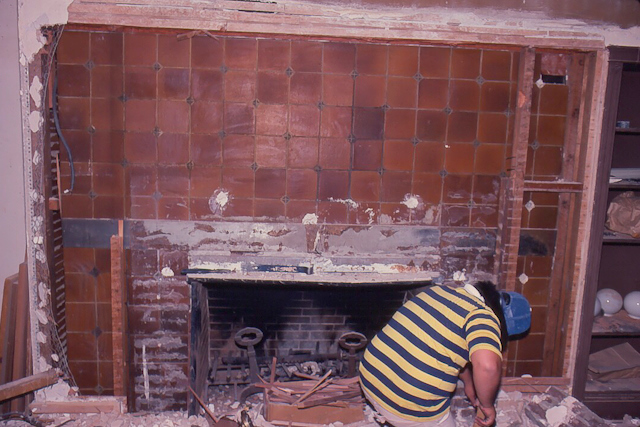
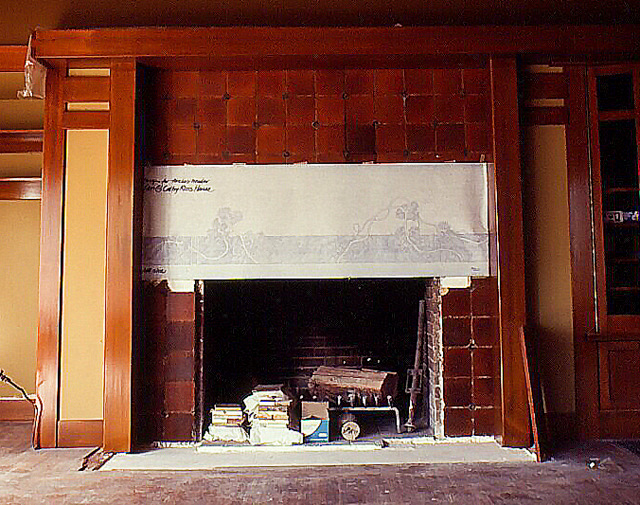
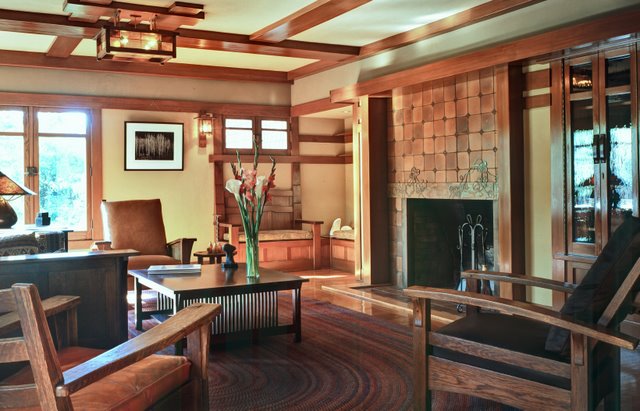
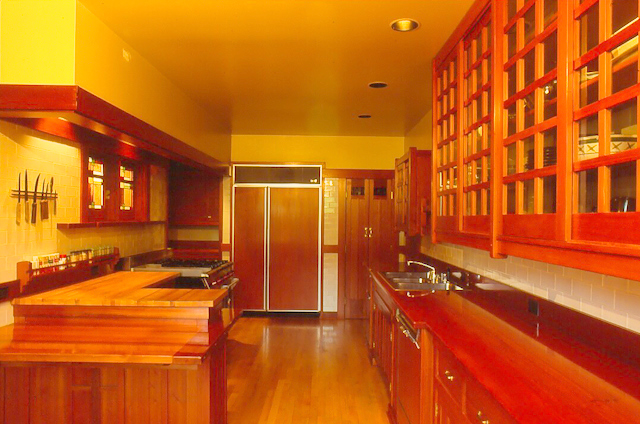
Early view shows entry porch with deep eaves and a shallow flat bay for stair landing.  Open terrace extended the same depth as porch originally, but was cut back and enclosed  in 1918 remodel.This pre-1918 photograph shows original width of house.  Entry appears larger, because it is in scale with overall width.  Additions expanded the house 9 feet on the left and 6 feet on the right.Recent photo by photographer John Muir shows our restored terrace to the left of entry.  This helped to restore balance; the  recessed  terrace counters projecting bay.View of restored entry hall shows original stair and 58" wide entry door.  Note the Greenes' art glass in door.  We employed their trailing vine motif for new firebox header.  Photo is coutesy of Popular Woodworking.When we removed canvas that had been glued to living room walls and ceilings in 1918 remodel we found  the Greenes' original paint colors and a perfect impression of box beams and trim.  We rebuilt these in Port Orford cedar.  Clearly, those big windows to the right had been added later.  Hmm.We also found buried in the wall the Greenes' orignial Grueby tile fireplace!  It, too, was covered in 1918 remodel.  We were eager to restore it, but holes had been punched in corners of some tiles to secure a new Tudor mantle. To cover damaged tiles we designed a new cooper firebox header.  Metalsmith cut design from a full size drawing we provided.  Trailing vine leaps at the right moments to cover holes in tiles.  Okay, we admit it was a more glamorous solution than necessary.  Historians want our scalps.Serene view of restored living room, courtesy of photographer Alex Vertikoff, shows original features we reproduced based on a tiny pre-1918 photo.   Small casements (found in the basement) above new bench, box beams, and trim were all installed by master craftsman Glen Stewart. New fireplace header was intended to have patina of an old copper penny, and to blend with Grueby tile.  Photo courtesy of John Muir.View of restored dining room looks south to sunny alcove.  Greenes used mahogany for paneling and trim.  Alcove had been a later addition.  We added posts, benchs and paneling to better integrate it with dining room.  Photo coutesy of John Muir.Original kitchen was lost decades earlier, but its narrow footprint remained.  Our kitchen design replaced a 1952 remodel done in Chuckwagon Modern.  New cabinets were modeled on those in the Gamble House.  Glen Stewart built them on-site in clear heart redwood.Recent view shows our galley kitchen with windows facing backyard.  Redwood lantern we designed for breakfast table was moved to a more prominent spot visible from entry.  Photo is coutesy of John Muir.
back
In the early 1980s we partially restored the 1906 W.T. Bolton house in Pasadena, California, by architects Charles and Henry Greene.  The house had been modified and enlarged several times, and original features lost. Some early changes, like the 1918 bay window, had acquired historic status.  When possible, we recovered the Greenes' original designs.  Living room terrace was reopened.  Much of the interior was restored, but living room features and kitchen had to be entirely rebuilt.
Tim Andersen Architect